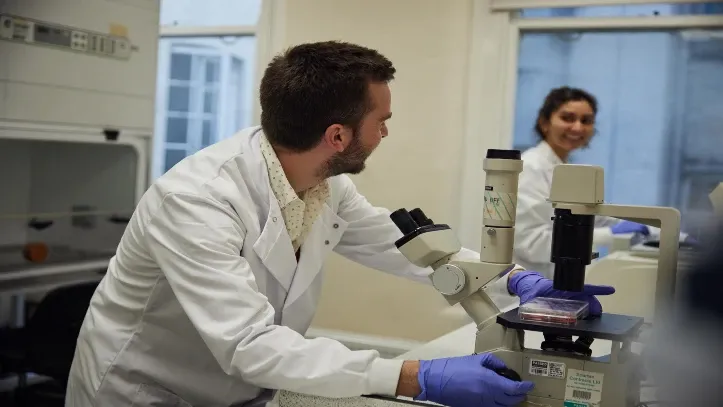
We take a look at some of the exciting diabetes research developments announced in August 2026, and what the findings could mean for people living with or affected by diabetes.
In this month's article:
- Muscle-boosting molecule released during exercise could help tackle diabetes-related muscle weakness
- Endometriosis could be linked to type 2 risk
- Genetic risk score could uncover missed type 1 diabetes diagnoses
Muscle-boosting molecule released during exercise could help tackle diabetes-related muscle weakness
New research we funded has identified a molecule released during exercise that could help protect against muscle weakness linked to type 2 diabetes.
People living with type 2 diabetes are more likely to experience muscle weakness and fatigue, which can make staying active more difficult and affect quality of life. While regular physical activity can help keep muscles strong and healthy, scientists don't fully understand exactly how the body adapts to exercise.
Professor Lee Roberts and team at the University of Leeds investigated a molecule called L-BAIBA, which is released by muscles during exercise. To better understand its role, the team studied mice, human muscle cells and volunteers taking part in exercise studies.
They looked at how increasing levels of L-BAIBA affected muscle function, as well as what happened when the body's ability to produce the molecule was reduced.
The researchers found that mice given L-BAIBA showed improvements in muscle strength, endurance and energy production. When the molecule was added to human muscle cells in the lab, it encouraged the development of muscle fibres better suited to longer periods of activity.
They also found that levels of L-BAIBA increased after exercise and were higher in people who were more physically fit. Levels also increased after people completed a 10-week exercise training programme, suggesting the molecule plays an important role in helping the body adapt to regular physical activity.
To test whether L-BAIBA was actively involved in these changes, the researchers reduced the body's ability to produce the molecule. This limited some of the usual benefits of exercise, providing further evidence that L-BAIBA helps muscles respond to physical activity.
The team then explored whether L-BAIBA could help protect against muscle problems linked to type 2 diabetes. In mice with obesity and type 2 diabetes, those given L-BAIBA performed better during exercise and were protected against several signs of muscle dysfunction, including weakness, fatigue and problems producing energy.
Anna Morris, our Assistant Director of Research said:
“Exercise plays an important role in managing type 2 diabetes, but for many people muscle weakness and fatigue can make staying active a real challenge.
"This research helps us better understand how muscles adapt to exercise and identifies a potential new target for improving muscle health. While these findings are still at an early stage, they could help shape future approaches that support people with type 2 diabetes to remain active and live healthier, longer lives.”
Endometriosis could be linked to type 2 risk
Results of a recent study suggest that women with endometriosis have a higher risk of developing type 2 diabetes than women without endometriosis - and that this risk changes depending on which subtype of the condition women have.
Endometriosis is a long-term condition where tissue similar to the lining of the womb grows in other places. This can cause chronic pain - and may affect fertility. There are different subtypes of the condition, depending on where the tissue grows.
Previous research studies have reported mixed findings on whether endometriosis and type 2 diabetes could be linked. But these studies may not have considered the different subtypes of endometriosis.
In the study published in Diabetologia, researchers analysed data on nearly 3 million women to explore whether different subtypes of endometriosis are linked to type 2 diabetes risk. They also examined how menopause, BMI, and a history of gestational diabetes influence type 2 risk.
The researchers found that:
- Women with endometriosis had a 46% higher risk of type 2 diabetes compared with women without endometriosis.
- Women’s type 2 risk differed by endometriosis subtype.
- Type 2 risk was higher for premenopausal women with endometriosis than postmenopausal women.
- Type 2 risk was higher for women with a lower BMI (<30 kg/m2) and women with endometriosis remained at increased risk whether or not they had a history of gestational diabetes. These are factors typically associated with a lower risk of type 2.
While this study shows links between the conditions, it does not show that endometriosis directly causes type 2 diabetes. The findings point to the need for continued research to further understand why the conditions may be linked, and whether this knowledge could help to improve future ways of assessing type 2 diabetes risk.
Genetic risk score could uncover missed type 1 diabetes diagnoses
Findings from research we funded suggest that some people tested for a rare genetic form of diabetes may actually have atypical type 1 diabetes, helping to explain cases that might otherwise go undiagnosed.
Getting the right diabetes diagnosis is crucial. It helps people access the right treatment, support and information they need to manage their condition confidently. But for some people, working out which type of diabetes they have is not always straightforward.
One example is maturity-onset diabetes of the young (MODY), a rare form of diabetes caused by a change in a single gene that can share features with both type 1 diabetes and type 2 diabetes.
Genetic testing can confirm whether someone has MODY, but many people who are referred for testing receive a negative result, leaving them without clear answers about what type of diabetes they have.
Our researchers at the University of Exeter wanted to find out whether a type 1 diabetes genetic risk score could help explain some of these unresolved cases. By showing whether people haves genes that are linked with type 1 diabetes, it can give doctors an extra clue and help identify people whose diabetes may actually be type 1.
The team analysed data from 1,129 people who were treated with insulin and had genetic testing for MODY. They found that among people whose MODY test was negative, around 16% had a genetic profile consistent with atypical type 1 diabetes.
Overall, the approach identified around 180 people whose diabetes may actually be atypical type 1 diabetes. The findings were particularly striking in children, where more than three-quarters of those with a negative MODY test had a genetic profile consistent with type 1 diabetes.
The approach is now being incorporated into NHS testing pathways, meaning more people could benefit from a clearer and more accurate diagnosis in the future, thanks to our research.