Page saved! You can go back to this later in your Diabetes and Me Close

Lisa’s story: Navigating an early-stage type 1 diabetes diagnosis

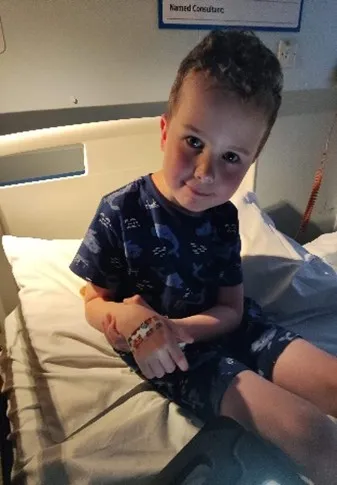
Jack sitting on a hospital bed

Jack

"Since Jack has started insulin, his family, friends and school staff have mentioned how much more energy he has. He is our little super star and has been so brave and resilient."

Lisa is a diabetes specialist nurse from Oxford, and lives with type 1 diabetes. Her son, Jack, was found to be in the early stages of developing type 1.

In this story, Lisa shares Jack’s experience of early detection and talks about her involvement in the UK Islet Autoantibody Registry – a Diabetes UK research project working to improve care for people identified as being at risk of type 1 diabetes or in its earliest, symptom-free stage.

Diagnosis

How it all started

In 2021, when Jack was 5 years old, we noticed he appeared extremely tired. We thought, 'he’s just started school so he’s likely just tired from all the playing and learning'.

I have type 1 diabetes myself – I was diagnosed aged 8. My dad also had type 1 diabetes – he was diagnosed aged 2. So, I wanted to get Jack checked.

I took him to the GP and they did a HbA1c test, which came back normal. I felt relieved - maybe I was worrying for nothing?

Fast forward eight or so months later, Jack had started complaining of tummy ache on and off and was still very tired and lethargic. I convinced Jack to let me check his glucose on my blood glucose meter before his evening meal. It was 10.2 mmol/L.

The next day, he was seen at our local hospital. His glucose levels were up and down, but not consistently high. That’s when he had a blood test to check for type 1 diabetes autoantibodies.

Autoantibodies are proteins used by the immune system to earmark insulin-producing cells for destruction. A simple blood test can detect if someone has autoantibodies, and how many. When there are two or more autoantibodies, the immune system’s attack has already started, and it’s almost certain someone will develop type 1 diabetes in their lifetime. This phase – before symptoms appear or insulin treatment is needed – is known as early-stage type 1 diabetes.

We got the results back a month or so later and found out he had tested positive for three autoantibodies. That’s how we discovered Jack was in the early stages of type 1 diabetes.

Monitoring blood glucose levels

We were referred to a clinic in Oxford that specialised in early-stage type 1 diabetes. Jack had check-ups every 3 months to check his blood glucose levels and monitor any progression. It was nice to know that Jack was being reviewed and there was some kind of plan in place for if things changed – that made us feel a lot better.

Jack unfortunately became unwell at the end of March 2024 with a fever and a rash, and his younger brother had seen Jack drinking from the tap in the bathroom. We followed the team’s advice and tested Jack’s blood glucose levels. They were really high.

We got in touch with the diabetes team and they told us Jack has progressed to the full onset of type 1 diabetes. He was then started on low doses of insulin.

Journey with diabetes

Transitioning

We were relieved to have caught Jack’s full type 1 diagnosis when we did and prevented a hospital admission for him. His diagnosis almost felt like a ticking time bomb - not a matter of if, but when it would happen. Of course, we didn’t want Jack to get full-blown type 1 diabetes, but we also didn’t want him to end up very poorly in diabetic ketoacidosis (DKA).

They say knowledge is power. However, knowing that your child has positive antibodies but not knowing when the full diagnosis will happen is hard - it could be months or could be years! Knowing we had support and follow up from the team in Oxford was amazing and definitely helped us.

"We know we were really lucky to have access to this. Across the UK there isn’t the same level of care everywhere for people with early-stage type 1 diabetes. That’s why we think Diabetes UK’s funding for the UK Islet Autoantibody Registry is so important."

The Registry will allow researchers to track and monitor everyone with autoantibodies as they progress towards full-blown type 1 diabetes. That means others can get proactive monitoring, like Jack did, to pick-up when they need to start on insulin.

It will also help to recruit people with autoantibodies to clinical trials testing treatments to delay or possibly prevent the full onset of type 1 diabetes. And it will be crucial to help researchers better understand the early stages of type 1 development, and create more personalised care approaches and public health policies that support early intervention and education.

Since Jack has started insulin, his family, friends and school staff have mentioned how much more energy he has. He is our little super star and has been so brave and resilient.

________________________________________________________________________________________________________________________________

Reach out for support

If you are affected by the topics highlighted within this story or other stories on our website, you can access support from our helpline team on 0345 122 2399, Mon- Fri, 9am- 6pm, or email helpline@diabetes.org.uk.

You can join our free forum – to connect with others affected by diabetes (minimum age 13). For more information, see our forum FAQs.

For those aged 11-25 living with type 1 diabetes, check out our youth programme Together Type 1 for a supportive community of people who understand what it’s really like juggling the ups and downs of life with diabetes.

Back to Top
Brand Icons/Telephone check - FontAwesome icons/tick icons/uk