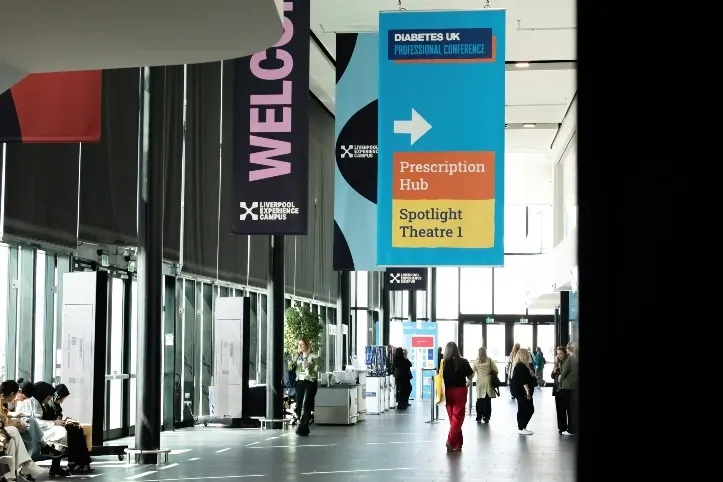
Last week our Professional Conference (DUKPC) in Liverpool brought together researchers and healthcare professionals to share the latest breakthroughs shaping the future of diabetes care. Dr Lucy Chambers, Head of Research Impact and Communications at Diabetes UK, shares her standout takeaways from the event.
Looking back on an incredible DUKPC, I genuinely feel so privileged to work alongside such an ambitious, collaborative and caring group of diabetes researchers and professionals. The collective drive to improve lives for everyone affected by diabetes is something really special. People affected by diabetes should feel encouraged and reassured that there’s a powerful community behind them, pushing relentlessly for better.
The grandest of challenges
DUKPC is my fourth diabetes conference in 8 months, and across all of them one thing has been clear. Decades of research into type 1 diabetes has now accumulated such a weight of evidence that we are at a genuine tipping point.
A future is increasingly in sight where insulin is no longer the only option for people with type 1. A future where we can get ahead of the immune attack that destroys insulin‑producing beta cells, protecting them before they are completely lost. And for people whose beta cells have already been wiped out, a future where we can replace them and keep them safe from immune attack once they are in the body.
At DUKPC, we heard updates on cutting-edge research funded through the Type 1 Diabetes Grand Challenge, a partnership between us, the Steve Morgan Foundation, and Breakthrough T1D UK, that’s a key part of the global effort to transform the treatment of type 1 diabetes.
The Grand Challenge recognises that the clearest path to a cure lies in restoring beta cells and protecting them from immune attack, and it is funding research on both fronts.
We heard from Rosie Sullivan and Dr Lydia Daniels‑Gatward about their work harnessing MSC cells (essentially cellular handymen) to support beta cells made in the lab, helping them function better and survive for longer once transplanted into people with type 1.
We also heard updates from each of the Grand Challenge’s Senior Fellowships. Professor James Cantley shared progress on identifying drugs that could encourage new beta cells to grow, and surviving beta cells to replicate, directly within the pancreas.
Professor Victoria Salem described her mind-bending work to develop a hydrogel protective coat that can encapsulate lab-made beta cells, shielding them from immune attack while still allowing them to connect to the blood supply and survive long‑term.
From Professor Sarah Richardson’s fellowship, we heard from Dr Teifion Luckett about a major breakthrough explaining why type 1 is often more aggressive in young children, opening up new possibilities for prevention and treatment.
The Grand Challenge is deliberately single-minded in its mission to bring together the world’s best scientists to shorten the path to new treatments and, ultimately, a cure for type 1 diabetes.
It is a genuine highlight of my career to be part of a programme that is enabling a community of ambitious, collaborative and extraordinarily clever researchers to tackle the toughest challenges in type 1 diabetes.
The Grand Challenge recognises that current treatments for type 1 diabetes fall short, and that the huge mental and physical energy required to manage this condition 24/7, alongside the very real risk of life-limiting complications and shortened life expectancy, is simply unacceptable. And that change cannot come soon enough.
The latest in gestational diabetes
Gestational diabetes (GDM) affects the lives of thousands of women in the UK every year, around one in 20 pregnancies. It raises the risk of poorer health outcomes for women and their babies during pregnancy and at birth, but critically its effects don’t stop there.
We know that around 50% of women who experience GDM will go on to develop type 2 diabetes within five years of giving birth. The impact also spans generations: children exposed to GDM in the womb have a higher lifetime risk of developing obesity and type 2 diabetes themselves.
At DUKPC, we heard from Professor Erica Gunderson, whose research shows that women who experience GDM are at higher risk of developing cardiovascular disease later in life, even if they don’t go on to develop pre‑diabetes or type 2 diabetes after pregnancy. Her work also shows that breastfeeding for six months or longer can halve this cardiovascular risk.
But this sits alongside a challenging reality. In a talk by Dr Sarah Dib, we heard that women with GDM often face multiple and significant barriers to breastfeeding. While evidence shows that targeted postpartum support can improve breastfeeding rates among women with GDM, many women just aren’t receiving this support.
A highlight was Professor Claire Meek's outstanding Harry Keen Rank Nutrition Lecture. Claire delivered a powerful account of her research on (and personal experience of) diabetes in pregnancy, including the Diabetes UK‑funded DiGest trial, which is building the evidence base for a new dietary‑based clinical approach to GDM. This represents a critical missing piece of current care and has the potential to improve health outcomes for thousands of mums and their babies each year.
A major barrier preventing women with GDM from getting the care and support they need is stigma. We heard about new findings from Diabetes UK-funded research led by Prof Angus Jones and Dr Rita Forde. They show that more than half of women with GDM in the UK experience stigma - from healthcare professionals, family, friends and wider society, both during pregnancy and after birth. Our campaign to reduce stigma for all types of diabetes is more important than ever.
Updates from DUKPC were a powerful reminder that enabling women to have safe, supported and healthy pregnancies should be a top priority for all of us, because the health of women, their babies, their families, and future generations depends on it.
Why inclusive research is a must
Another standout moment of DUKPC was Professor Sarah Finer's superb RD Lawrence Lecture. Sarah’s principled, thoughtful and collegiate approach to inclusive research is transforming the future of diabetes care for people who have historically been left out of health and genetic research, helping to address the unacceptable diabetes inequities we see for British South Asian and Black people.
Sarah co-leads the world-renowned Genes & Health study. This rich, open‑access resource is revealing how to better prevent, diagnose and treat diabetes in South Asian people. It brings together genetic data from around 75,000 British Bangladeshi and Pakistani people with over three million person‑years of linked NHS health records.
Around one in eight adults in east London have signed up! That level of engagement doesn’t happen by chance. It reflects years of trust building, community partnership and meaningful involvement in all stages of research design and delivery.
Sarah also co‑leads the Black Health Legacy initiative, which aims to improve health outcomes for Black, Black African and Black Caribbean communities by tackling their long‑standing under‑representation in health and genetic research. This is a relatively new study, launching in November 2025, but one that holds just as much potential for positive change as Genes & Health.
One recent and striking discovery from Sarah’s work is that certain previously undetected genetic variants, commonly carried by Black and South Asian people, can cause falsely low HbA1c readings. Given that HbA1c is the mainstay test used in the NHS (and globally) to diagnose and monitor type 2 diabetes, the implications for people’s health are huge.
Prof Finer’s work demonstrates how inclusive research can surface hidden assumptions and biases in even our most fundamental approaches to diabetes care, and how addressing them can ripple benefits right through the system.
I left DUKPC 2026 buzzing, and feeling proud to work for the UK’s leading diabetes charity that supports a dedicated community of researchers, policy makers, healthcare professionals and people with diabetes to improve the future for everyone affected. See you next year!