Knowing your blood sugar levels helps you manage your diabetes and reduce your risk of serious complications, both now and in the future.
On this page:
- What are blood sugar levels?
- Can I check my own blood sugar levels?
- Why test blood sugar levels?
- How to check your blood sugar levels
- HbA1c test
- What are healthy blood sugar levels for my target range?
- What if my blood sugar levels are too low?
- What if my blood sugar levels are too high?
What are blood sugar levels?
Your blood sugar levels, also known as blood glucose levels, are a measurement that shows how much glucose you have in your blood.
Glucose is a sugar that you get from food and drink. Your body uses it for energy. Your blood sugar levels go up and down throughout the day. If you have diabetes, these changes are usually larger and happen more often than they do in people without diabetes.
Can I check my own blood sugar levels?
Not everyone with diabetes needs to check their levels themselves at home. You’ll need to if you take certain diabetes medication. Always talk to your healthcare team if you’re not sure whether you should be doing this – they’ll give you advice on whether to check them yourself and how often.
There are two main ways to check your own sugar levels. You can do a finger-prick test which uses a blood glucose meter to give the result, or you can wear a small sensor called a continuous glucose monitor (CGM) which sends the results to a device such as your phone. Checking your sugar levels helps you keep an eye on them, understand how food or activity affects them and helps you to know how much medication you may need.
There’s also something called an HbA1c, which is a blood test that measures your average blood sugar level over the last three months. Everyone with diabetes is entitled to this check. How often you'll have this test will depend on your type of diabetes, your treatment and what the result is.
High blood sugar levels increase your risk of developing serious complications. However you manage your diabetes, stay in the know about your blood sugar levels.
Why test blood sugar levels?
If you take certain medication, like insulin or sulphonylureas, checking your blood sugar levels is a vital part of living with diabetes. It can help you work out when you need to make changes to your medication, when you need to eat something or if you need to make any changes for physical activity.
Routine checks can help you know when you might be starting to go too low (called a hypo) or too high (called a hyper). It’s a way of getting to know your body and how it works. It can help you and your healthcare team spot patterns too. If you use a finger-prick test to check your levels, it can be helpful to write the results down.
But importantly, checking them will help you stay healthy and prevent serious diabetes complications now and in the future. Complications of diabetes include eye problems, foot problems, heart attacks, nerve damage, and other chronic (long-term) issues. They are caused by high blood sugar levels over time which can damage the blood vessels and nerves. This reduces blood flow and can change the feeling in different parts of the body.
The higher your blood sugar levels are and the longer they’re high for, the more at risk you are. If you want to know more head to our complications hub.
How to check your blood sugar levels
Continuous glucose monitors
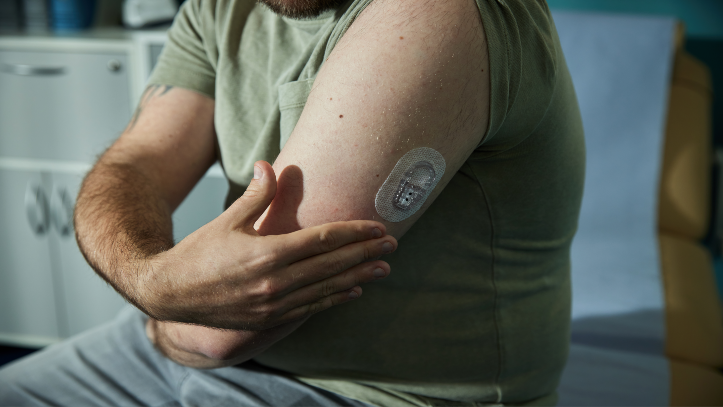
More and more people with diabetes are choosing to use a CGM to check their sugar levels.
Continuous glucose monitoring means that you can check your sugar levels without needing to prick your finger. You wear a small sensor on your body day and night that reads your sugar levels and sends the results by Bluetooth so you can see them on your mobile phone. Alternatively, if you use FreeStyle Libre 2 Plus sensors, you can scan the sensor with a device called a reader to get the results.
But continuous glucose monitoring doesn’t measure the sugar in your blood. It measures the amount of sugar in the fluid surrounding your cells, called interstitial fluid.
It’s not quite as accurate as a finger prick test, as the results can lag behind blood sugar readings by up to 15 minutes. And the difference between blood sugar levels and CGM readings is more likely to be bigger when you’re eating or exercising.
Even if you’re offered a CGM by your healthcare team, it’s important that you still get a blood glucose meter and test strips on prescription to let you do finger-prick checks.
Find out if you're eligible for a free CGM on the NHS.
Monitors like CGMs are available for purchase for people without diabetes but it is important to note these cannot be used to diagnose diabetes or prediabetes. Diagnosis can only be done by blood tests, which your GP can arrange.
There is also currently very little published evidence on the use of CGM in people without diabetes, so people need to be careful when relying on the results to make decisions about health.
We are not in a position to advise on CGM use in people without diabetes and recommend people speak to the providers of their device for further information.
Finger-pricking
This is how you find out what your blood sugar level is at that moment in time. It’s a snapshot.
Your healthcare team will show you how to do the test, and it’s important that you’re taught how to do it properly, otherwise it could affect your result.
For some people, finger-prick testing isn’t a problem, and it quickly becomes part of their normal routine. For others, it can be a stressful experience, and that’s totally understandable. Knowing all the facts and speaking to other people can help – contact our helpline or chat to others with diabetes on our online forum.
Watch our video and follow our simple steps on how to test your blood sugar levels safely and correctly.
We have more information for you if your child has diabetes and you’re checking their blood sugar levels for them.
You’ll need these things to do the test:
- a blood glucose meter
- a finger-prick device and lancet (the needle that goes into the finger-prick device)
- some test strips that are compatible with your blood glucose meter
- a sharps bin, so you can throw the needles away safely.
If you’re missing one of these, speak to your healthcare team.
Blood glucose testing meters
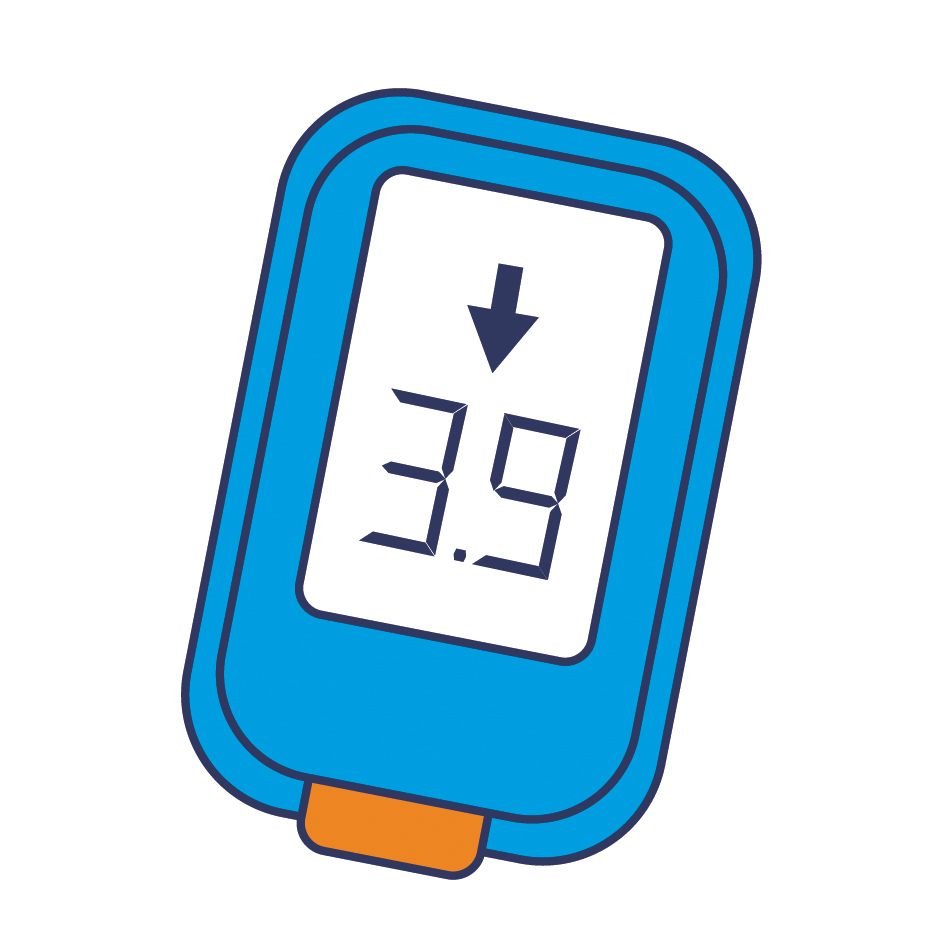
New meters come on the market all the time, so it can be tricky choosing the right one. It’s best to ask your healthcare team for advice on a meter that’ll suit you.
If you have sight problems, you may not be able to use some meters, so your healthcare team can suggest alternatives.
Some people are given a meter by their diabetes healthcare provider. But if you choose to buy your own meter, you might not get a prescription for the test strips it uses. So it can be helpful to talk to your health care team about whether testing is right for you, what meters they provide or recommend and whether you'll be able to get the test strips on prescription.
Finger-prick devices and lancets
Finger-prick devices pierce the skin with a needle so that a drop of blood can be taken for testing. The needle is called a lancet.
You can adjust the device to change how far the lancet goes into the skin. The depth you need will depend on the thickness of the skin.
Lancets come in different sizes and thicknesses (or gauges). A higher-gauge lancet is thinner, so it is normally less painful, but it might not always give you enough blood.
You should only use a lancet once, or they get blunt and are painful to use. The lancets should be disposed of in a sharps bin.
Test strips
Test strips usually come in batches of 50 and are individual to the type of meter. This means you have to have the right test strips for your meter.
If you are refused test strips, talk to your GP. If that doesn’t work, contact your local Integrated care board (ICB). They are responsible for planning and funding healthcare services.
If you decide to buy strips from outside the UK or online, you’ll need to check they’re adjusted to UK specifications.
How to do a finger-prick test
Your healthcare team will show you how to do it the first time, but these are the key steps:
Wash your hands with soap and warm water and make sure to dry your hands thoroughly. Don’t use wet wipes as they may contain chemicals or additives which can affect the test result. Make sure your hands are warm so it’s easier to get blood.
Remove the cap from your finger-prick device and put in a new lancet. Then put the cap back on and set the device by pulling or clicking the plunger. Your device is now ready.
Take a test strip and slot it into the meter to turn it on. Some meters will have test strips built in.
Choose which finger to prick but avoid your thumb or index finger (finger next to your thumb). Also try to avoid the middle of your finger or too close to a nail. Place the finger-prick device against the side of your finger and press the button. Use a different finger each time.
Take your meter with the test strip and hold it against the drop of blood. It will draw the blood into the test strip so it can give you the result. It’ll tell you if the test strip is filled, usually by beeping.
If you struggle to get enough blood from your finger, talk to your diabetes nurse for advice. But you may also find these practical tips useful:
- Make sure the finger is warm as this will bring the blood closer to the surface.
- After pricking your finger, hold your hand down towards the floor for about 5 seconds. This allows the blood vessels time to recover, and gravity will help bring the blood to the surface.
Before you look at your reading, check your finger. Use a tissue to stop bleeding, then take out the lancet and throw it away in your sharps bin.
By this time, your meter will probably show the result. Note it down.
You can use the same tissue to remove the test strip from your meter, then you can throw the test strip and tissue into your normal general waste bin. Taking out the strip will usually turn the meter off.
Make a note of your readings
It may sound obvious, but you should record your readings. Note them down in a diary, a notebook or in your phone calendar. Some meters have software that lets you do this. There are also some diabetes Apps available for you to do this.
You and your healthcare team can then look back over your results to see if you need to adjust your treatment.
HbA1c test
As well as any regularly testing your own blood sugar levels, at least once a year your healthcare team will ask you to come in for an HbA1c blood test. Although you should have this test at least once a year most people will have the test every three to six months. This checks your average blood sugar levels over the last three months. It is an important blood test that gives a good indication of how well your diabetes is being managed.
This is one of your essential diabetes health checks, and it’s important you understand what your results mean. A high HbA1c means you’re more likely to develop diabetes complications, like serious problems with your eyes and feet. It's important to have this test regularly so you can work with your diabetes team if needed to help reduce your risk of getting complications.
We’ve got more information about the HbA1c test and what your levels mean.
What are healthy blood sugar levels for my target range?
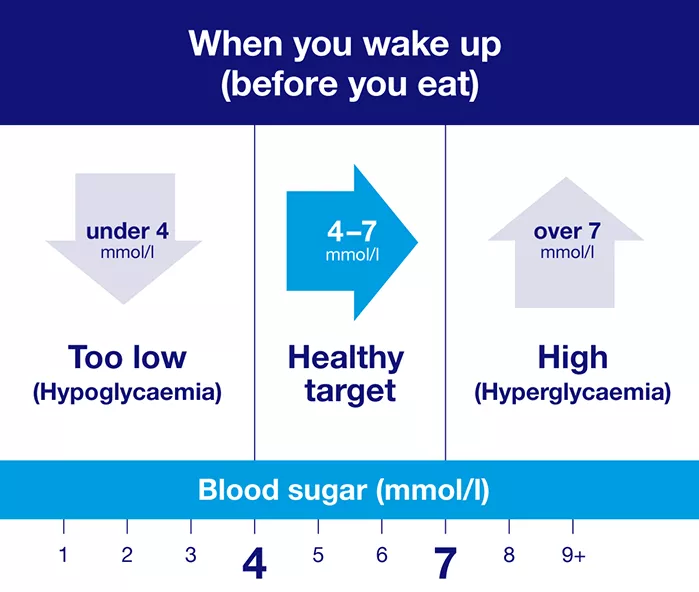
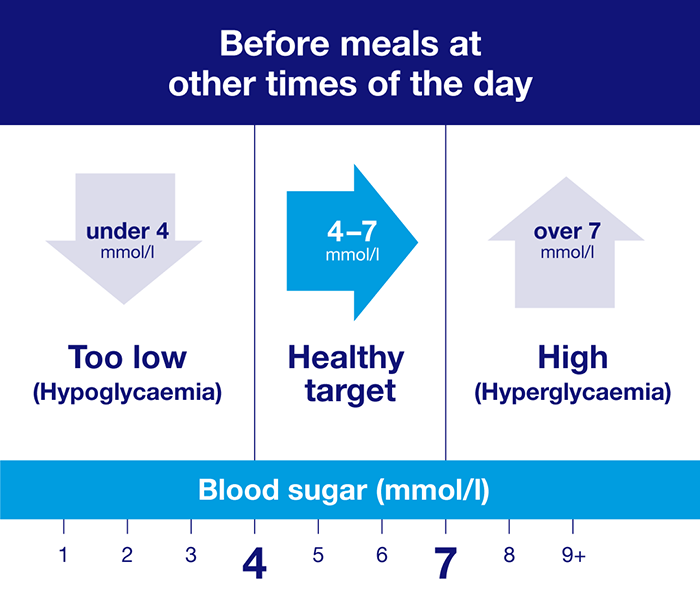
These are general blood sugar level targets for adults living with diabetes. Your individual targets may differ.
Blood sugar levels are measured in mmol/l, which stands for millimoles per litre.
You might be asking, what's the normal range for blood sugar levels? The answer is, there is a healthy range that you should ideally be aiming for. The infographics above show general guidelines, but your individual target blood sugar range may be different.
Your healthcare team will agree with you what it is. If you don't know what your target blood sugar range is, ask your diabetes team at your next appointment
You’ll get different readings at different times of the day, depending on what you're doing, such as what you've eaten and how much you are moving around.
Here’s a guide to help you get started on finding your target range:
If you’re a child with type 1 diabetes:
- When you wake up and before meals: 4 to 7mmol/l
- After meals: 5 to 9mmol/l.
If you’re an adult with type 1 diabetes:
- When you wake up and before meals: 5 to 7mmol/l
- Before meals at other times of the day: 4 to 7mmol/l
- After meals: 5 to 9mmol/l at least 90 minutes after eating.
A bedtime target should be agreed with you by your healthcare team too.
If you have type 2 diabetes:
- There are currently no NICE recommendations for these types of blood sugar targets if you have type 2 diabetes. If you live with type 2 diabetes, it’s important that you speak to your healthcare team about your individual blood sugar targets. You can read our HbA1c page to learn about HbA1c targets in type 2 diabetes, and our Time in Range page to learn more about target ranges.
Pregnant women with any form of diabetes, including gestational diabetes:
- Fasting: below 5.3mmol/l
- One hour after meals: below 7.8mmol/l
- If you’re not able to check until two hours – rather than one hour – after a meal, you should aim for below 6.4mmol/l
- Pregnant women should aim to keep blood sugar levels above 4 mmol/l to reduce the risk of hypoglycaemia.
Remember your individual target range for your blood sugar levels may be different. Your healthcare team will agree with you what it is and help you reach these targets, so you can reduce the risks for you and your baby.
We have lots more information to help you if you’re planning to have a baby or you’re pregnant now.
What happens when your blood sugar levels are too low?
A hypo is when your blood sugar level, also called blood glucose level, drops too low. This is usually below 4mmol/l. Hypos need to be treated immediately; otherwise your blood sugar levels can drop further. If this happens, you may experience a severe hypo and need emergency treatment.
There are many different symptoms of a hypo, so it’s important that you are aware of the signs in case your blood sugar level drops too low. We’ve also got more information about what to do if you are having a hypo.
What happens when your blood sugar levels are too high?
If youIf your blood sugar levels are slightly above your targets, there are usually no symptoms. But if your blood sugar levels become too high, you may experience some symptoms associated with a hyper.
The blood sugar level at which symptoms start can be different for everyone. Common symptoms include needing to go for a wee more often, feeling very thirsty, feeling tired and having headaches.
It’s important that you know how to treat a hyper to avoid developing ketones in the blood.
We’ve also got more information about what to do if you are having a hyper.
Here's how we ensure our content is accurate and reliable by PIF standards